Mercury
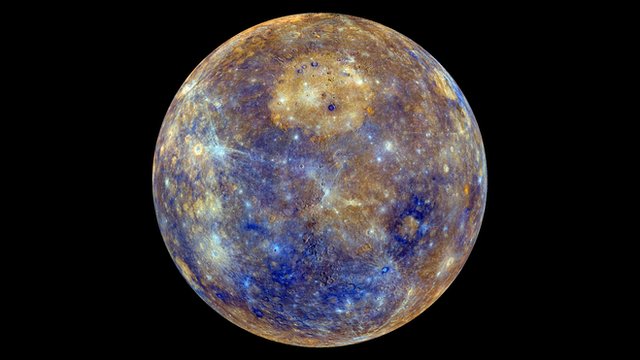
Mercury is the first planet in the solar system . In appearance to the Moon’s, mercury’s surface appears heavily collapsed indicating that it has been geologically inactive for billions of years. It is the smallest among all the other planets. Its orbital period around the Sun is 87.97 days which is the shortest of all the planets in the Solar System. The planet Mercury is named after the Roman deity Mercury, the messenger of the gods. Its orbital eccentricity is the largest of all known planets in the Solar System. Mercury’s distance from the Sun is only about two-thirds (66%) of its distance at aphelion. Mercury orbits the Sun within Earth’s orbit as an inferior planet, and never exceeds 28° away from the Sun. It is the innermost planet in the solar system. When viewed from Earth, the planet can be seen only near the eastern or western horizon, during the early evening or early morning. At this time it may appear like a bright star-like object, but is often far more difficult to observe than Venus. The planet when viewed telescopically displays the complete range of phases, which is similar to Venus and the Moon, as it moves in its inner orbit relative to Earth, which reoccurs over the so-called synodic period approximately every 116 days.
Across the equatorial regions, having almost no atmosphere to retain heat, it has a surface temperatures ranging from 100 K (-173 °C; -280 °F) at night to 700 K (427 °C; 800 °F) during the day that varies among all the other planets. The polar regions are constantly below 180 K (-93 °C; -136 °F). The planet has no known natural satellites. Mariner 10 which flew in 1974 and 1975; and Messenger which was launched in 2004, are the two spacecrafts that have visited mercury. The two spacecrafts orbited Mercury over 4,000 times in 4 years before exhausting its fuel and crashing into the planet’s surface on April 30, 2015. In a 3:2 spin-orbit resonance, mercury rotates in way such a way that it is unique in the solar system since it is gravitationally locked with the sun. For every two revolutions, it rotates on its axis exactly three times when it goes around the Sun when seen relative to the fixed stars. In a frame of reference that rotates with the orbital motion, it appears to rotate only once every two Mercurian years, when it is viewed from the sun. Therefore, an observer on Mercury would see only one day every two years.
Solar System | Mercury | Venus Moons | Earth | Mars Moons | Jupiter Moons | Saturn Moons | Uranus Moons | Neptune Moons | International Space System | ISS Research | Moons of the planet | Magnetosphere | Regions Of Comets | Space Station Glossary | Space Station Abbreviation | Space Station Sitemap | Asteriods | Contact Us