Solar System
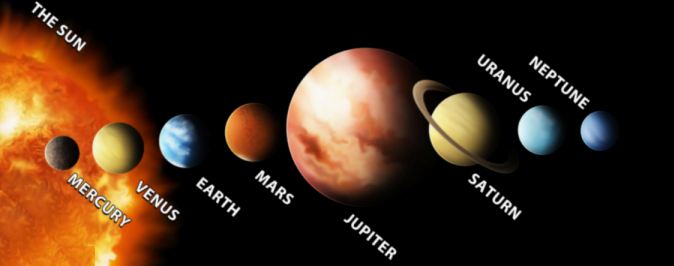
The solar system is comprised of our Sun and the retinue of celestial objects gravitationally bound to it. Traditionally, it is said to consist of the Sun, nine planets and their 158 currently known moons; however, a large number of other objects, including asteroids, meteoroids, planetoids, comets, and interplanetary dust, orbit the Sun as well.
Age Of Solar System
Scientists estimate that the solar system is 4.6 billion years old. To calculate this figure, they examine an unstable element, which is subject to radioactive decay. By observing how much this element has decayed, they can calculate how old this element is. The oldest rocks on earth are approximately 3.9 billion years old, however it is hard to find these rocks as the earth has been thoroughly resurfaced. To estimate the age of the solar system, scientists must find rocks from space, such as meteorites – which are formed during the early condensation of the solar nebula. The oldest meteorite was found to have an age of 4.6 billion years, hence the solar system must be around 4.6 billion years old.
Evolution Of Solar System
By the disintegration of massive, disseminate cloud of gas and dust for over 4.5 billion years results in the formation of our entire solar system, including planets, comets and asteroids. The planets, asteroids and comets in the solar system are loose particles left over from the formation of the sun.
Several light years across (1 light year approximately 10,000,000,000,000 kilometers (or 6 trillion miles) the sun was core of the cloud formed from the gas and dust particles which is much larger solar system. The rotation of core was slow at first, but as it collapsed it spun faster, like a spinning ice-skater pulling in their arms. The rotation prevented the core’s equator from collapsing as fast as the poles, so the core became a spinning disc. Gas and dust in the disc spiraled gradually in to the center, where it accumulated to form the Sun. Because dust is denser than gas, some of the dust settled to the mid-plane of the disc. These dust particles stuck together to make clumps, then clumps stuck together to make rocks, then rocks collided to formulate planets. The hydrogen and other gases form the outer layers for these planets. Hence the sun is the collapsed core of an interstellar gas cloud and the planets, asteroids and comets are small lumps of dust which stayed in orbit instead of spiraling into the Sun.Regions Of The Solar System
Our solar system is divided into three regions:
The inner solar system, including terrestrial planets and the main asteroid belt.
Including the giant planets, their satellites and the centaurs, and
The outer solar system, comprises the area of the Trans-Neptunian objects including the Kuiper Belt, the Oort cloud, and the vast region in between. Our inner solar system contains the Sun, Mercury, Venus, Earth and Mars.The main asteroid belt lies between the orbits of Mars and Jupiter. The planets of the outer solar system are Jupiter, Saturn, Uranus, Neptune and Pluto.
Solar System | Mercury | Venus Moons | Earth | Mars Moons | Jupiter Moons | Saturn Moons | Uranus Moons | Neptune Moons | International Space System | ISS Research | Moons of the planet | Magnetosphere | Regions Of Comets | Space Station Glossary | Space Station Abbreviation | Space Station Sitemap | Asteriods | Contact Us